 boo@zjmgmm.com / 958587858@qq.com
 English
 русский
 Español
 عربى
عربى
Standard Rack-Mount (Server Rack) Type: A rectangular metal enclosure (typically 440 mm wide × 450 mm deep × 130 mm high for a 5 kWh unit) designed to slide into a 19-inch equipment rack. These units have front-panel displays showing state of charge (SOC), voltage, current, and temperature. The BMS communicates via CAN bus or RS485 to external inverters. Common capacities: 4.8 kWh (100 Ah at 48 V) or 9.6 kWh (200 Ah at 48 V). Rack-mount types dominate residential and small commercial solar storage.
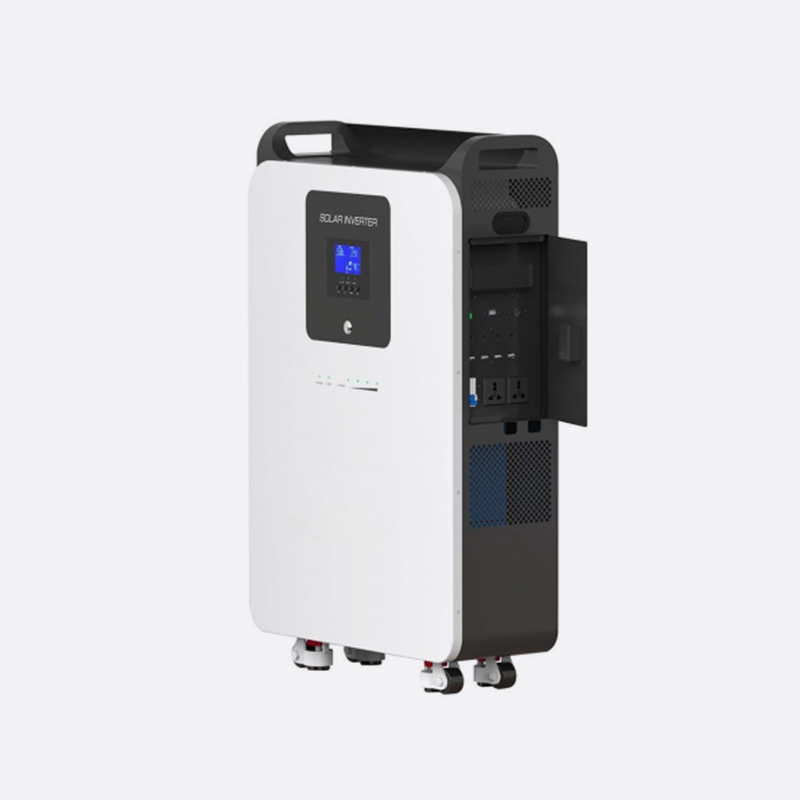
Blade or Slim Profile Type: A flat, wall-mounted unit less than 100 mm thick, often hung vertically like a picture frame. Capacities range from 2 to 5 kWh. The slim profile allows installation in garages or on interior walls where floor space is limited. The BMS and contactors are arranged in a line along the bottom edge to keep the thickness minimal. Cooling is passive (natural convection) because forced air requires additional depth.
Stackable Modular Type: Individual battery modules of 1 to 2 kWh each (height 150-200 mm) that stack vertically and connect in parallel or series via jumper cables. A stack of 4 to 8 modules reaches 5 to 15 kWh. Each module has its own BMS, and one master module communicates with the inverter. Stackable types are used in RVs and small off-grid cabins where users want to start with a small capacity (e.g., 2 kWh) and add modules later without replacing the entire system.
All-in-One Power Station Type: A portable unit containing the LiFePO₄ battery, an inverter (pure sine wave, 1,000 to 3,000 W), a solar charge controller, and AC/DC charging ports inside a single carrying case with a handle. Capacities range from 500 Wh to 3,000 Wh. Outputs include AC outlets (110 V or 230 V, depending on region), USB-C (up to 100 W), and 12 V car ports. The BMS manages both charging and discharging across all ports simultaneously.
Drop-in Lead-Acid Replacement Type: A battery that physically matches the dimensions of Group 24, Group 27, Group 31, or GC2 (golf cart) lead-acid batteries. The case is black plastic (ABS or polycarbonate) with automotive-style terminal posts (SAE or threaded studs). Nominal voltage is 12.8 V (4 cells in series). Capacities range from 50 Ah to 300 Ah. The BMS is sealed inside and provides low-temperature cutoff (below 0°C charging protection). These are used to upgrade existing RVs, boats, and golf carts without modifying the battery tray.
Material Properties of Lithium Iron Phosphate Integrated Batteries
Cathode Material (Lithium Iron Phosphate, LiFePO₄)
The cathode is the defining component of this battery chemistry. LiFePO₄ has an olivine crystal structure (orthorhombic space group Pnma). The iron and phosphate groups form a three-dimensional framework with lithium ions occupying channels. Key properties: theoretical specific capacity of 170 mAh/g, actual capacity of 140-160 mAh/g in commercial cells. Operating voltage is flat at 3.2 to 3.3 V versus lithium metal, with a cutoff of 2.5 V (discharge) and 3.65 V (charge). The iron-phosphate bond (P-O) is strong (bond energy 480 kJ/mol), making the material thermally stable up to 270°C before decomposition. In comparison, lithium cobalt oxide (LCO) decomposes at 150-200°C. This thermal stability is the primary safety advantage of LiFePO₄. The material is not toxic and contains no cobalt, reducing both cost and environmental concerns. The tap density (packing density of the powder) is 1.0 to 1.5 g/cm³, lower than LCO (2.0-2.5 g/cm³), which contributes to lower volumetric energy density.
Anode Material (Graphite)
The anode is synthetic or natural graphite with a layered structure (space group P63/mmc). Lithium ions intercalate between the graphene layers during charging. The theoretical capacity of graphite is 372 mAh/g; commercial anodes achieve 340-360 mAh/g. The anode is typically 1.5 to 2.0 times thicker than the cathode to account for the lower density of lithiated graphite. The solid electrolyte interphase (SEI) layer forms on the graphite surface during the first few charge cycles, consuming 5-10 percent of the lithium inventory (the reason for "formation cycles"). The SEI layer is composed of lithium carbonate (Li₂CO₃), lithium alkyl carbonates, and LiF. Its thickness stabilizes at 20-50 nm after formation. A stable SEI is critical for battery life; a damaged SEI leads to continuous lithium consumption and capacity fade.
Separator
The separator is a microporous polyolefin membrane, typically polypropylene (PP) or polyethylene (PE), or a trilayer PP/PE/PP. Thickness is 20 to 30 microns for prismatic and pouch cells, 30 to 40 microns for cylindrical cells. Porosity is 40 to 55 percent, with pore sizes of 0.03 to 0.1 microns (small enough to block dendrites but large enough for ion passage). The separator has a shutdown feature: at 130-140°C (for PE) or 160-170°C (for PP), the pores close, stopping ion flow and cutting off the current before thermal runaway. Tensile strength in the machine direction is 100-150 MPa, and 10-15 MPa in the transverse direction. The separator wets easily with the carbonate-based electrolyte (contact angle <30 degrees after plasma treatment).
Current Collectors
The cathode current collector is aluminum foil (99.5 percent purity, 15 to 25 microns thick). The anode current collector is copper foil (99.9 percent purity, 10 to 20 microns thick). The foil surface is treated (etched or coated with a carbon layer) to improve adhesion of the electrode slurry. Contact resistance between the foil and electrode coating is typically 0.5 to 2 ohm·cm². The tabs connecting the current collectors to the external terminals are nickel-plated copper (cathode) and pure nickel (anode) to prevent galvanic corrosion. The tabs are welded to the foils using ultrasonic welding, with weld strength of 20-50 N.

 English
  Building 33, Demonstration Park, No. 318 Chenguang Road, Eastern New District, Wenling City, Taizhou City, Zhejiang Province, China
  0086-576-86337978
  0086-576-86333878
 boo@zjmgmm.com